7 min read
Plato Feared Money. Adam Smith Understood It.
Plato forbade his rulers to touch gold or silver, while Adam Smith saw money as what holds a specialized society together.
- Reading list
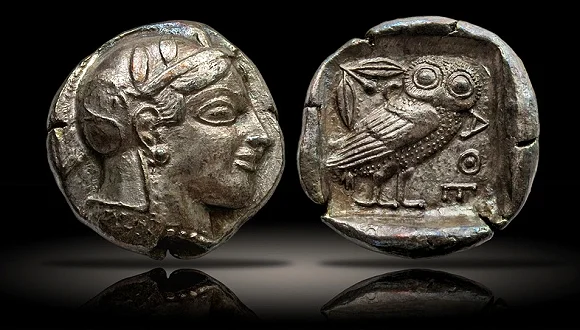
In The Republic of Plato, the Athenian philosopher envisions an ideal city whose rulers are forbidden to touch gold or silver. More than two thousand years later, Adam Smith, often regarded as the father of modern economics, built his account of society on the opposite premise: it is not from the benevolence of the butcher that we expect our dinner, but from his regard to his own interest.
Both thinkers confront the same profound question: what does money do to human nature? Plato associates it with the appetitive part of the soul, a force that must be contained if justice and social harmony are to endure. Smith, in The Essential Adam Smith, recognizes money as what stabilizes the system of specialization and channels self-interest toward the common good. Of the two, Smith demonstrates the superior understanding of money.
Who Does What
Plato and Smith both advocate for specialization in the labor force, but the application of this system to society is different. Plato envisions a rigid societal structure where individuals are assigned roles based on their innate abilities - guardians, auxiliaries, and craftsmen. Plato (2016) argues with Thrasymachus through the character Socrates,“each one must practice one of the functions in the city, that one for which his nature made him naturally most fit” (p.111). This perspective reflects Plato’s belief in fixed societal roles to achieve harmony and balance. As Paul J. McNulty (1975) also agreed, “Plato’s vision focuses on an artisan economy with fixed social and economic stratification” (p.374). Hence, even though Plato’s approach assumes that each citizen obtains their personal satisfaction internally through the correlated part of souls to a specific role, this system ultimately prioritizes communal stability over individual liberty.
On the other hand, Smith rejects this fixated approach and presents specialization as a dynamic process influenced by numerous factors such as habit, education, and opportunity. He illustrates this by describing rural Scotland, where “every farmer must be butcher, baker, and brewer for his own family” (Smith, 1986b, p.171). This example highlights that roles are not predetermined but adapt to circumstances. Individuals essentially have the freedom to explore multiple paths and fulfill their unique potential. This adaptability not only enhances productivity and efficiency but also fosters personal satisfaction. Unlike Plato’s static system, Smith’s model empowers individuals to actively shape their roles where personal choice and economic efficiency coexist.

Money plays a crucial role in stabilizing Smith’s system of specialization and amplifies the benefit of division of labor due to offering an efficient exchange of goods and services. Smith (1986b) explains, “Every man thus lives by exchanging, or becomes in some measure a merchant, and the society itself grows to be what is properly a commercial society” (p.172). Foremost, whilst specialization facilitates efficiency and the production of high-quality goods, the exchange processes in earlier systems such as barter or the use of metals were often cumbersome and inefficient. Barter systems posed significant challenges due to incompatibilities in value and the lack of a standardized medium of exchange (Smith, 1986b, p.172). At the same time, metals remained flawed due to scarcity and logistical limitations despite being an improvement of barter. The concept of money introduces a standardized and widely accepted medium of exchange, offering convenience, scalability, and equity. Smith’s vision of bringing equality through a physical form of transaction creates a dynamic and self-sustaining economy, as well as rights and fairness in each specialized field.
What People Are Like
Smith and Plato significantly distinguish themselves in their interpretations of human nature, which shape their views on money. Plato fundamentally divides human nature into three components: reason, spirit, and appetite. He associates money with the appetitive part, warning of its potential to foster greed and disrupt societal harmony. Plato (2016) projects this concern through Socrates, stating that the “money-loving part will be called by the name 'appetitive,' since it is most naturally attached to gain and money” (p.261). For Plato, unchecked desire for wealth stems from this appetitive nature, and without proper control, it can lead to chaos and injustice. His solution is to limit the influence of money by promoting moderation and assigning leadership roles to a class of rulers who are “lovers neither of money nor of gain” (Plato, 2016, p.68). Plato's ideal city is designed to curtail the dark side of human nature by ensuring that wealth does not dominate societal priorities.
Adam Smith, however, takes a more optimistic view of human nature, seeing it as a source of economic potential. He recognizes that individuals are primarily motivated by self-interest, and this self-interest can eventually drive productive and socially beneficial behavior. As Smith (1986b) famously states, “It is not from the benevolence of the butcher, the brewer, or the baker that we expect our dinner, but from their regard to their own interest” (p.169). Here, Smith argues that self-interest is the engine of economic activity but also acknowledges that self-interest is not uncontrollable because of humanity’s inherent sociability and desire for mutual benefit based on Smith’s Theory of Moral Sentiments. In addition, he describes the human “propensity to truck, barter, and exchange,” emphasizing that trade is a natural extension of human cooperation (Smith, 1986b, p.168).
Furthermore, money, according to Smith’s framework, channels human desires productively. Rather than viewing the appetitive side of human nature as a threat, Smith sees it as a driving force for economic progress when guided by trade and division of labor. Money facilitates fair and efficient exchanges, reducing the drawbacks of barter and enhancing the market’s ability to meet individual and societal needs. It also reflects the physical advantages of division of labor, time-savings, and the quality of goods. This optimistic perspective on human nature positions Smith’s understanding of money as a tool for growth and cooperation, in stark contrast to Plato’s more restrictive view.
Who Money Serves
Plato’s skepticism about money arises from his belief that it can foster greed and destabilize communal harmony. As Andrea Schriefl (2018) explains in her article, “Plato advocates for rulers who serve without compensation to prevent the corrupting influence of wealth” (p.194). This uncompromising viewpoint reflects his belief that human nature must be tightly controlled to preserve societal harmony. He insists that money and self-interest must be subordinated to the collective good, advocating for rulers who serve without compensation to prevent corruption. This vision, while idealistic, assumes that human nature is inherently prone to excess and willing to sacrifice societal collapse for their own good.
Smith contradicts Plato’s skepticism by demonstrating how money can align self-interest with the common good. Through trade, specialization, and fair exchange, money creates a system where individuals pursuing their interests contribute to the prosperity of society. His Theory of Moral Sentiments states, “His actions are the objects of the public care. Scarce a word, scarce a gesture, can fall from him that is altogether neglected” (Smith, 1986a, p.80). He explains that humans are guided not only by self-interest but also by a natural desire for social approval and sympathy. As John Dwyer (2005) analyzes, “sociability was innate and not some moral sense. All human beings had a propensity toward sympathy.” (p.663). This sociability ensures that economic activity is tempered by ethical considerations, fostering harmony and avoiding the unchecked greed that Plato fears. By framing money as a facilitator of cooperation rather than a corrupter of morals, Smith presents a more practical and adaptable framework. His view acknowledges human imperfection but leverages it for economic and social progress. Unlike Plato, who emphasizes control and restraint, Smith’s approach fosters innovation, freedom, and shared prosperity.
Plato’s philosophy emphasizes controlling human nature to preserve the common good and a just city, viewing money as a potentially corrupting force. Adam Smith, however, embraces human nature as a driver of economic progress, advocating for money as a medium of exchange that supports specialization, mutual benefit, and social harmony. By leveraging self-interest and fostering cooperation, Smith’s understanding of money offers a pragmatic and effective framework for promoting the common good in society.